Last week I drove from our canal cellar in Utrecht to the studio in Amsterdam. Somewhere on the motorway it struck me that I’ve had this conversation at least ten times in the past few months: “Can’t we just record at home? Or use AI?” The answer is always the same: it depends. But that nuance deserves more than a shrug. So here are the pros and cons, no detours.
When recording at home works just fine
If you’re just starting out, recording at home is the smartest choice.
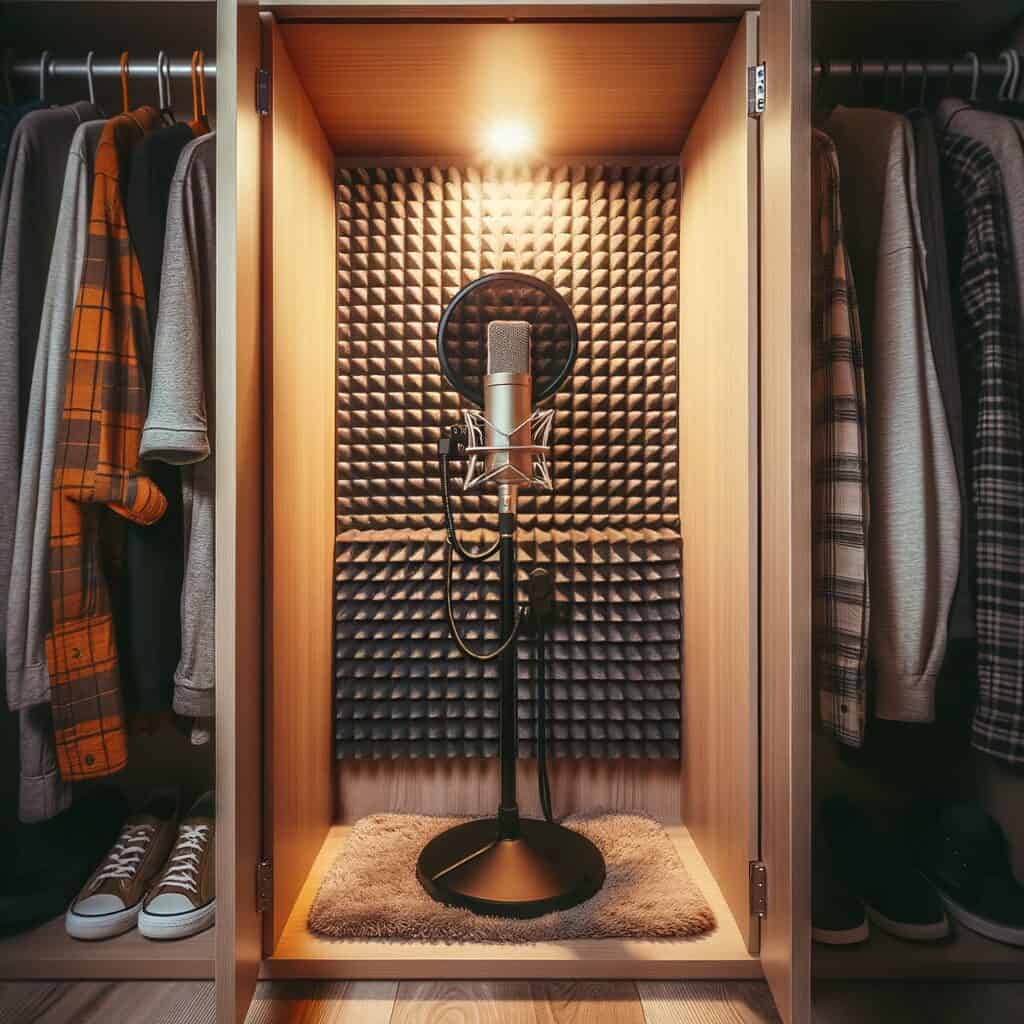
With a condenser microphone of around a hundred euros, a wardrobe full of clothes behind you and a quiet room, you’ll get a long way. Most listeners are forgiving as long as your story holds up. What does make them drop off: audible echo, constant background noise, or traffic that sounds louder than you do.
Recording at home works well when you:
- Want to test a format before you invest
- Record informal, conversational talks
- Interview guests remotely
- Are in season one and managing your budget deliberately
We don’t often say it out loud in a first meeting, but: just start at home. Get to know your format. Find out what lands. Only then does a studio upgrade really make sense.
AI voices and AI help: use them wisely, don’t overestimate them
AI has reached the podcast world, and the technology is impressive. Modern AI voices speak multiple languages, adjust their tone and imitate emotional nuance ever more convincingly.
Yet in practice we notice something else: people feel it. They can’t always put their finger on it, but the connection isn’t there. We’ve tested high-quality AI voices on professional scripts, and every time someone said: “It sounds perfect, but where’s the soul?”
The costs also work out differently than you’d expect. Generating an AI voice is fast, but then the real work begins: refining tone, correcting odd pronunciations, adjusting rhythm. That costs more studio time than a professional speaker who gets it right in one session. Sometimes you spend more money repairing AI than on a real recording.
That said: we use AI ourselves too, but smartly. If a date was recorded wrong, a name needs changing or the last word of a sentence got cut, we fix that quickly without the guest having to come back to Utrecht for three words. As a tool it works excellently. But as the main voice of your podcast it’s a different story.
(A small but important note: never use AI cloning of a voice without written permission from the speaker. The legal side is serious and so is the ethical one.)
When a professional podcast studio really makes the difference
There comes a point where home recording hits its ceiling. That moment arrives sooner than most people expect.
A client once sat down behind the microphone himself and listened back to a recording. “This microphone doesn’t sound like a microphone,” he said. I asked what he meant. “It doesn’t feel like I’m listening to a recording, but as if I’m hearing exactly the same thing as when I listen to someone without a microphone and headphones. It sounds so natural that I no longer hear the difference between a recording and a real conversation.” That’s what good equipment in a good room does: the technology disappears.
The moment a podcast becomes your organisation’s calling card, for clients, partners or an audience that doesn’t know you yet, quality counts in how you come across. Listeners judge on sound without realising it. A clear, warm voice in an acoustically treated room radiates trust before you’ve finished your first sentence.
What a professional studio gives you that you rarely achieve at home:
- Acoustic treatment: no echo, no reverb, no humming fridge in the background
- Professional equipment: microphones and monitoring that aren’t realistic at home
- Technical guidance: someone who listens live and steers before it’s too late
- Video in 4K: for YouTube, LinkedIn and social, from the same session
- Sound design and music: a recognisable sound of your own, not royalty-free stock music
Big Orange’s canal cellars on the Oudegracht in Utrecht have brick, wood and a characteristic low ceiling. That combination gives a warm, living acoustic you can’t reproduce at any home location. That sounds like marketing talk, but it’s simply the physics of acoustics.
How do you make the smartest choice?
The best solution depends on where you are. We roughly see this pattern:
Professional studio
When the podcast is the face of your organisation, reaches clients or runs for several seasons. Here quality is an investment that pays off.
Recording at home
When you’re testing, have an informal format or are in the start-up phase. Good, when used deliberately.
AI as a tool
For corrections, updates and multilingual versions of existing material. Not to replace a real voice.
And don’t forget: podcast content isn’t disposable. A good episode is still online three years later. That very durability makes quality an investment that pays off.
What we learned from the Rijksmuseum
In 2013 the Rijksmuseum reopened after ten years of renovation. They didn’t want a standard audio tour, no monotone voice, no “in front of you is painting number 47.” Big Orange pitched a completely new approach: actors, dialogue, soundscapes, real experience. They won and became preferred supplier.
That project was only possible thanks to professional production. Not because a home microphone fell technically short, but because the combination of acoustics, actor direction and sound design produced something the Rijksmuseum has used worldwide for years.
The same principle applies to podcasts. If your podcast is the voice of your organisation, the sound may match.
Start at home. Grow from there.
Start at home if you’re just beginning. Test, learn, discover what works. But do you want a podcast that strengthens your brand, builds trust or reaches clients? Then it’s worth trying a professional studio at least once. And simply hearing the difference.
Want to see how that sounds and feels? Come by our studio in Utrecht or Amsterdam. We’re happy to think along with you about what suits your story best.
Do you have experience with home recordings, AI voices or a professional studio? What worked? What didn’t? Let us know, we’re curious.